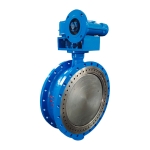
An Analysis of the Technological Development and Engineering Applications of Cone Valves —Applications of Xitie Valve Technology Co., Ltd.’s Medium-Sized Cone Valves, Sleeve Cone Valves, and Other Products in Water Conservancy Projects
Release time: 2026-10-29 16:19:19
As China’s water conservancy infrastructure development continues to advance, the performance requirements for regulating and pressure-relief valves in hydroelectric power stations, reservoirs, water diversion tunnels, and municipal flood control projects are becoming increasingly stringent. As a specialized regulating and pressure-relief valve for water conservancy applications, the conical valve plays a crucial role in flood discharge, pressure regulation, and drainage operations thanks to its unique conical plug flow-guiding structure and energy-dissipating and noise-reducing characteristics.
I. Structural Features and Operating Principles of Cone Valves
Cone valves utilize a conical plug flow-guiding structure, allowing water to diffuse uniformly along the conical surface. Stepless flow regulation is achieved through the axial movement of the sleeve. This structure enables the water flow to undergo energy dissipation within the valve, effectively reducing outlet velocity and noise while minimizing scouring of downstream pipelines and structures. Depending on the installation method and application scenario, conical valves can be classified into in-line conical valves, sleeve-type conical valves, end-discharge conical valves, and fixed conical valves, respectively suitable for mid-pipe regulation, sleeve-type flow control, free end-discharge, and fixed installation requirements.
II. Performance Advantages and Engineering Applicability
In terms of performance, conical valves are characterized by high-pressure resistance, cavitation resistance, and resistance to sediment scouring. They enable stepless flow regulation under load and are suitable for complex operating conditions such as high heads and sediment-laden flows. Their energy dissipation and noise reduction capabilities are outstanding, helping to improve the operational environment of the project. Additionally, conical valves integrate multiple functions—including flood discharge, pressure regulation, and drainage—into a single unit, thereby reducing the number of valves required and simplifying system layout.
III. Major Application Areas
Cone valves are primarily used in water conservancy projects such as hydropower plants, reservoirs, water diversion tunnels, municipal flood control, and tailwater pressure regulation at pumping stations. In hydropower plants, they can be used for turbine bypass, tailwater pressure regulation, and emergency discharge; in reservoir projects, they can handle flood discharge and drainage tasks; and in water diversion tunnels and pumping station systems, they can be used for flow regulation and pressure control. Different types of cone valves can be flexibly selected based on project layout conditions to meet diverse operational requirements.
IV. Product Applications by CTV Valve Technology Co., Ltd.
CTV Valve Technology Co., Ltd. specializes in the research, development, and manufacturing of conical valve products. Its product range includes in-line conical valves, sleeve-type conical valves, end-discharge conical valves, and fixed conical valves, among other series, providing selection support tailored to different head, flow rate, and sediment conditions. The company continuously optimizes the flow-guiding structure and energy-dissipation performance of conical valve cores, committed to providing reliable and flexibly adjustable regulation and pressure-relief valve solutions for water conservancy projects.
Conclusion
With their comprehensive performance characteristics—including energy dissipation, noise reduction, high-pressure resistance, cavitation resistance, and stepless regulation—conical valves offer stable application value in the field of regulation and pressure relief for water conservancy projects. As engineering design requirements for valve operational safety and regulation precision continue to rise, technical improvements and engineering adaptation of conical valves will remain key areas of focus for the industry.
More news recommendations